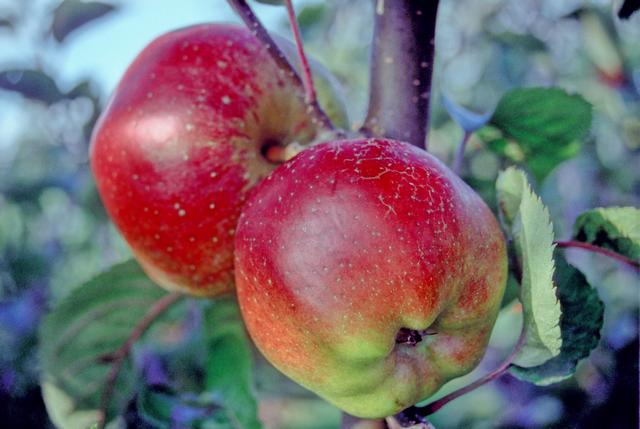
The Baldwin apple was once so popular in America that it has its own monument. It was also commemorated by the US Postal service on its 33 cents stamp back in 2013. For many years it was the most popular apple export in the country.
Baldwin is a 1700’s heirloom. It has also been known as ‘Calville Butter’, ‘Felch’, ‘Late Baldwin’, ‘Pecker’, ‘Red Baldwin’s Pippin’, ‘Steele’s Red Winter’, and ‘Woodpecker’.
Most of the commercial Baldwin crop was planted in New England. Much of it was wiped out in 1934, and remaining orchards were never replaced. As is often the case, newer orchards opted to plant more current varieties.
Baldwin is prized for cider and hard cider. West County Cider makes a specialty “Baldwin” cider from trees originally planted in 1900. It is also a good baking apple, as it holds its shape well.
Baldwin is a hard apple. In fact it is so exceptionally hard that the apples have few blemishes or blights, and need little in the way of pesticides. (Makes you wonder if the reason it was replaced had something to do with the fact dentures were wooden back then. It makes a good market apple because it doesn’t bruise easily.
Baldwin can last for months when properly stored.
Baldwin’s have a sweet-tart flavor that is often described as tasting like “wine and roses”. They have a high sugar content but maintain a balanced flavor profile. They are prized for cheese trays and baked goods.
Baldwin trees are hard to find, as very few are grown today. Planting one is a good way to help increase their numbers so that this historic tree does not become extinct.
Baldwin is a cold-zone apple. It thrives in Garrett County cooler winter temperatures but you should not plant this tree in areas above zone 6.
Pollinate with Crimson Crisp, Wolf River, Smokehouse, Summer Rambo, and Gold Rush. Tree will grow to be 18′ to 20′ at maturity and be free standing. It can handle some heavy clay soil but does not do well in wet areas. Baldwin ripens in October.