
Product Snapshot
If You Purchased Last Year
If you purchased trees from our sale last year please note that some of the varieties we had last year are on different rootstocks this year. This will change the attributes of those trees.
Make sure you look at the descriptions given with the trees that we are offering for sale this year. Don’t assume that if it is the same cultivar as you purchased last year, it will be exactly the same tree.
Ripening Dates
Apples
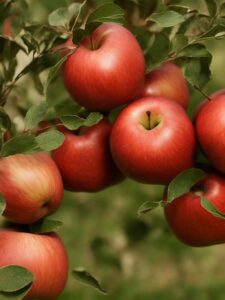
- Yellow Transparent Apple – late July to early August
- Wolf River Apple – Early to mid-August
- Summer Rambo Apple – Late August to September
- Sansa – Late August to September
- Liberty – September to Mid October
- Crimson Crisp – Mid September to mid October
- Smokehouse – Mid to late October
- Baldwin – Mid to late October
- Gold Rush – Late October to Mid November
Other Fruits
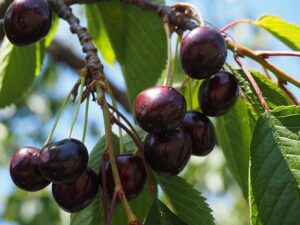
- Montmorency Cherry – Late June
- Stardust Sweet Cherry – Mid July
- Kristen Sweet Dark Cherry – Mid July
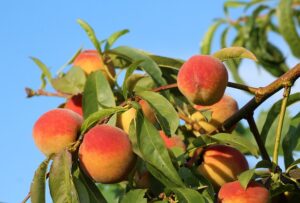
- Contender Peach – August
- Reliable Peach – August
- Madison Peach – August
- Harrow Sweet Pear – September
- Russeted Bartlett – September
- Potomac Pear – August – September
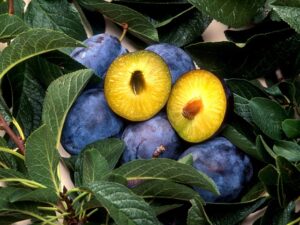
- Bluebyrd – Plum – Beginning September
- Long John Plum – September
- Kenmore NY9 Plum – September
- Shiro Plum – July
Complementary Pollinators
Apples
These apples are Late and Mid-Season Bloomers and will pollinate each other.
- Wolf River
- Smokehouse
- Summer Rambo (sterile)*
- Baldwin (sterile)*
- Crimson Crisp
- Gold Rush
Sold Previously – Northern Spy, Nova Spy, Fuji, Golden Delicious, Arkansas Black, Northwest Greening.
*Note: Baldwin and Summer Rambo are sterile. They cannot pollinate other varieties. But they can be pollinated by trees on this list.
These apples are Early and Mid-Season Bloomers and will pollinate each other.
- Smokehouse
- Liberty
- Sansa
- Yellow Transparent
- Summer Rambo
Sold Previously- Freedom, Fuji, Golden Delicious, Jonamac, Wilton’s Red Jonaprince
Pears
All of the pear varieties that we are offering will pollinate each other.
Peaches
All of the peach varieties that we are offering are self-pollinating but will benefit from pollination from any of the other peaches we are offering.
Plums
Cherries
All of the plum varieties that we are offering a self-pollinating but will benefit from pollination from any of the other peaches we are offering.
Montmorency and Stardust are self-pollinating
Kristen needs a pollinator and can be pollinated by Montmorency or Stardust.
Mature Tree Size
18 Foot to 20 Foot - Semi Dwarf
- Nova Spy Apple
- Northwest Greening Apple
- Yellow Transparent Apple
- Wolf River Apple
- Crimson Crisp Apple
- Long John Plum
15 Foot to 18 Foot - Short Semi-Dwarf
- Arkansas Black Apple
- Smokehouse Apple
- Jonamac Apple
- Northern Spy Apple
- Summer Rambo Apple
- Bluebyrd Plum
- Bartlett Pear
- Potomac Pear
- Red Bartlett Pear
10 Foot to 12 Foot - Dwarf
- Wiltons Red Jonaprince
- Stardust Sweet Cherry
- Kristen Sweet Cherry
Naturally Dwarfing Standard
- Montmorency Cherry – 15 Foot
- Contender Peach – 12 Foot to 15 Foot
- Veteran Peach – 10 Foot to 12 Foot
- Reliance Peach – 12 Foot to 15 Foot
Cold Hardiness
Extremely Cold Hardy - Zone 4 or below
- Northern Spy Apple
- Nova Spy Apple
- Summer Rambo Apple
- Yellow Transparent Apple
- Wolf River Apple
- Wilton’s Red Jonaprince Apple
- Northwest Greening Apple – (hardy to 50 below F)
- Arkansas Black Apple
- Smokehouse Apple – (hardy to 50 below F)
- Jonamac – (hardy to 50 below F)
- Montmorency Cherry
- Kristen Sweet Cherry
- Long John Plum
- Contender Peach
- Reliance Peach
- Veteran Peach
- Bartlett Pear
- Potomac Pear
- Red Bartlett Pear
Cold Hardy Enough for Garrett County But Don't Plant in a Frost Pocket - Zone 5a
- Crimson Crisp Apple
- Bluebyrd Plum
- Kenmore Plum
- Stardust Sweet Cherry
- Stanley Plum (is listed as zone 5a but has traditionally handled zone 4 temperatures)
Disease Resistance
Following is a listing of the disease resistance genetics of each apple cultivar for Fire Blight, Apple Scab, Powdery Mildew, and Cedar Apple Rust. Information is from Cornell University Susceptibility Rankings. It should be noted that this list of Disease Resistance was compiled by various breeders and organizations that may have had differing results with a specific cultivar. And as is particularly the case with heirlooms, disease resistance may vary in the results depending upon whether the trial happened in the area to which the tree is naturalized.
Heirloom varieties specific to a region have built immunity to various bacteria and virus’ in that region making them less susceptible to tree diseases than newer cultivars. However, that can vary from tree to tree. So, there is no guarantee. Some heirlooms were abandoned due to issues with diseases.
All of the heirlooms we are carrying are ones known to be naturalized in our area and they have had a history of successful growth in the Garrett County and surrounding region. Some of them may be susceptible to some diseases, which is a risk often associated with the purchase of heirlooms.
All of this is basically to say that with the newer cultivars, the list is probably pretty accurate. With the heirlooms, they may, or may not, have more disease resistance than is listed.
- Northern Spy – Resistant to Fire Blight. Very old heirloom.
- Nova Spy – Resistant to Apple Scab and Powdery Mildew
- Yellow Transparent – Resistant to Apple Scab, Powdery Mildew, and Cedar Apple Rust
- Crimson Crisp – Resistant to Apple Scab, Fire Blight, Powdery Mildew
- Wolf River – Resistant to Fire Blight, Apple Scab, and Powder Mildew
- Summer Rambo – Very old (1500’s) heirloom, no resistance documented
- Northwest Greening – Fire Blight. Very old heirloom
- Jonamac – Resistant to Fire Blight and Cedar Apple Rust
- Johnaprince – Resistant to Fire Blight and Cedar Apple Rust
- Smokehouse – Resistant to Cedar Apple Rust
- Arkansas Black – Resistant to Fire Blight and Powdery Mildew
- Stanley Plum – Has no disease resistance and is very susceptible to Black Knot.
- Bluebyrd Plum – Resistant to Black Knot, Plum Pox Virus, and Brown Rot.
- Long John Plum – Resistant to Black Knot. This particular Long John tree can be planted in heavy clay soil due to its specialty rootstock.
- Bartlett Pear – Is highly susceptible to diseases.
- Red Bartlett Pear – is susceptible to diseases.
- Potomac Pear – Resistant to Fire Blight
- Veteran Peach – Resistant to Clasterosporia, Cytosporosis, Peach Leaf Curl, Bactrial Spot, Powdery Mildew, and Brown Rot. Veteran is known as a good choice for a disease resistant peach.
- Contender Peach – Has good disease resistance, including Bacterial Leaf Spot, Leaf Curl, and Brown Rot.
- Reliance Peach – Resistant to Leaf Curl and Bacterial Spot.
- Montmorency Cherry – Has good disease resistance but is susceptible to Cherry Leaf Spot
Mature Tree Support Needs
Free Standing Once Trunk Reaches 4"
This means the tree would not need support under normal conditions. If it is in an area of high wind, or other factors that could put an abnormal strain on the trunk, it may still need to be supported.
Needs Support for Life of Tree
Some trees do not put down deep root systems. Or the trunk may not be as sturdy. In this event, the tree would need supported with stakes or some other support system for the life of the tree. Additionally, all dwarf trees should have support for the life of the tree because fruit production may be heavier than the tree can support.
- Wilton’s Red Jonaprince
- Crimson Crisp
- Northwest Greening
- Nova Spy
- Wolf River
- Yellow Transparent
- Jonamac
- Northern Spy
- Bailey Peach
- Reliance Peach
- Veteran Peach
- Montmorency Cherry
- Stardust Cherry
- Kristen Cherry
- Bartlett Pear
- Potomac Pear
- Red Bartlett Pear
- Bluebyrd Plum
- Stanley Plum
- Long John Plum
- Arkansas Black – EMLA 7
- Smokehouse – EMLA 7
- Summer Rambo – EMLA 7
Did you know that many of the trees sold in chain stores are on EMLA 7 rootstock? It has been the standard for semi-dwarf trees within chain tree sales for a very long time. The reason is because it is less expensive, it works in most soil types, and it produces a tree size that is popular with urban backyard growers. However, EMLA 7 doesn’t put down as deep of roots as many other rootstocks, and it is prone to breakage of the trunk. Therefore, even though most stores don’t tell you this, the tree should have some type of support for the life of the tree even if the trunk diameter seems like it should be sufficient to support the tree.
Whenever possible, we put our semi-dwarf trees that would be similar in size to EMLA 7 on a more expensive designer rootstock that has deeper roots and a sturdier trunk. If you are wondering if we sacrificed disease resistance and cold tolerance, the answer is “no”. Our designer rootstocks are actually even more cold hardy and have just as good of disease resistance.
With this said, some of our trees are on EMLA 7 simply because we had no choice. Since so many tree distributors want EMLA 7, some of the rarer varieties only come on that rootstalk. Just be aware that you will need some sort of support for these trees for the life of the tree, and in times of drought, you will need to water them more.